The Best Kids' Saffron of 2026: A Buyer's Guide
We tested the 43 most popular kids' saffron supplements. Only 5 passed the test that happens after your kid swallows it.


Most parents quit saffron for one reason:
They buy a bottle. They give it three weeks. Nothing changes. Same forty-minute morning routines. Same intense meltdowns. Same call from the teacher on Friday.
So they decide saffron doesn't work for their kid. They move on.
They're wrong. Here's what nobody tells you:
The saffron didn't fail. The number on the bottle did….
Before you continue reading, it's worth knowing who this actually matters for.
- ⚠️Kids 4–12 With Attention Or Impulse Struggles
- ⚠️Kids Who Only Move When You Raise Your Voice
- ⚠️Kids Whose Teachers Keep Emailing
- ⚠️Parents Not Ready To Start Medication
If you checked even one box: that's not defiance, and it isn't something you did. The brain's self-control center — start a task, stop an impulse, switch to the next thing — finishes building about three years late in these kids.11
You can't discipline a delay. Delays respond to support, not pressure.
Most parents here have made the same quiet choice you might have: not ready to medicate yet.
You're not the outlier. "Medicate or do nothing" was never the real choice.
But waiting isn't free either. Missed instructions turn into missed grades. Meltdowns turn into a reputation. By age 10, a lot of these kids stop believing they have a problem and start believing they are one.
Which is why so many parents land on saffron — as support for the part that's running late. Real studies, real children, scored by the parents and teachers who were with them all day:
- In 6 weeks, saffron kept up with the leading ADHD medication. In a randomized double-blind trial, kids taking saffron extract improved about as much as kids taking methylphenidate — the most-prescribed stimulant. Teachers and parents did the scoring, and they couldn't tell the groups apart.1
- Added on top of medication, results got even better. A second trial gave saffron to kids already on medication — and they improved more than medication alone, especially in the evenings, when stimulants wear off.2
- It helped the nights, not just the days. Saffron is also studied for sleep — the wind-down piece stimulants never touch.4
The first thing we found was in the fine print on the back.
The word that made those trials work isn't "saffron." It's safranal — the active compound. So the number that matters isn't the milligrams on the front, it's the percentage on the back.
The trials: 30mg at 6% safranal = 1.8mg of active compound.
A best-selling bottle: 88mg at 0.3% safranal = 0.26mg.
Three times the milligrams. One-seventh the active compound. A number with no percentage beside it is decoration.
The trick is legal, and most of the shelf runs on it. Four ways a label falls short:
- 1. It isn't a standardized extract. "Saffron stigma powder" is ground-up spice. The trials used extract, standardized for safranal and crocin.
- 2. The dose is fake-big. A large milligram number with a small percentage beside it — or no percentage at all. That's the 88mg-at-0.3% trick above, and it's the single most common failure on the shelf.
- 3. It's a gummy. A chew is mostly sugar, gelatin and dye — the ingredient gets whatever room is left. And what little is in there has to survive the trip. That's the second problem, below.
- 4. The doses are hidden. "Proprietary blend." Ten ingredients, no milligrams. Nobody hides a good number.
Fail one of the four and it doesn't matter how faithfully you give it. Sixty mornings, done perfectly, with a bottle that never had a chance.
That's the first problem, and most of the 43 failed on it alone.
The second one we weren't looking for. It turned up because two bottles that read almost identically on paper came back from the lab completely different.
A perfect label means nothing if it never gets absorbed.
The Absorption Problem
A supplement only works if it gets into your kid. Everything else is a number on a bottle.
That's bioavailability. We sent the top scorers to a third-party lab and had it measured, liquid against gummy:
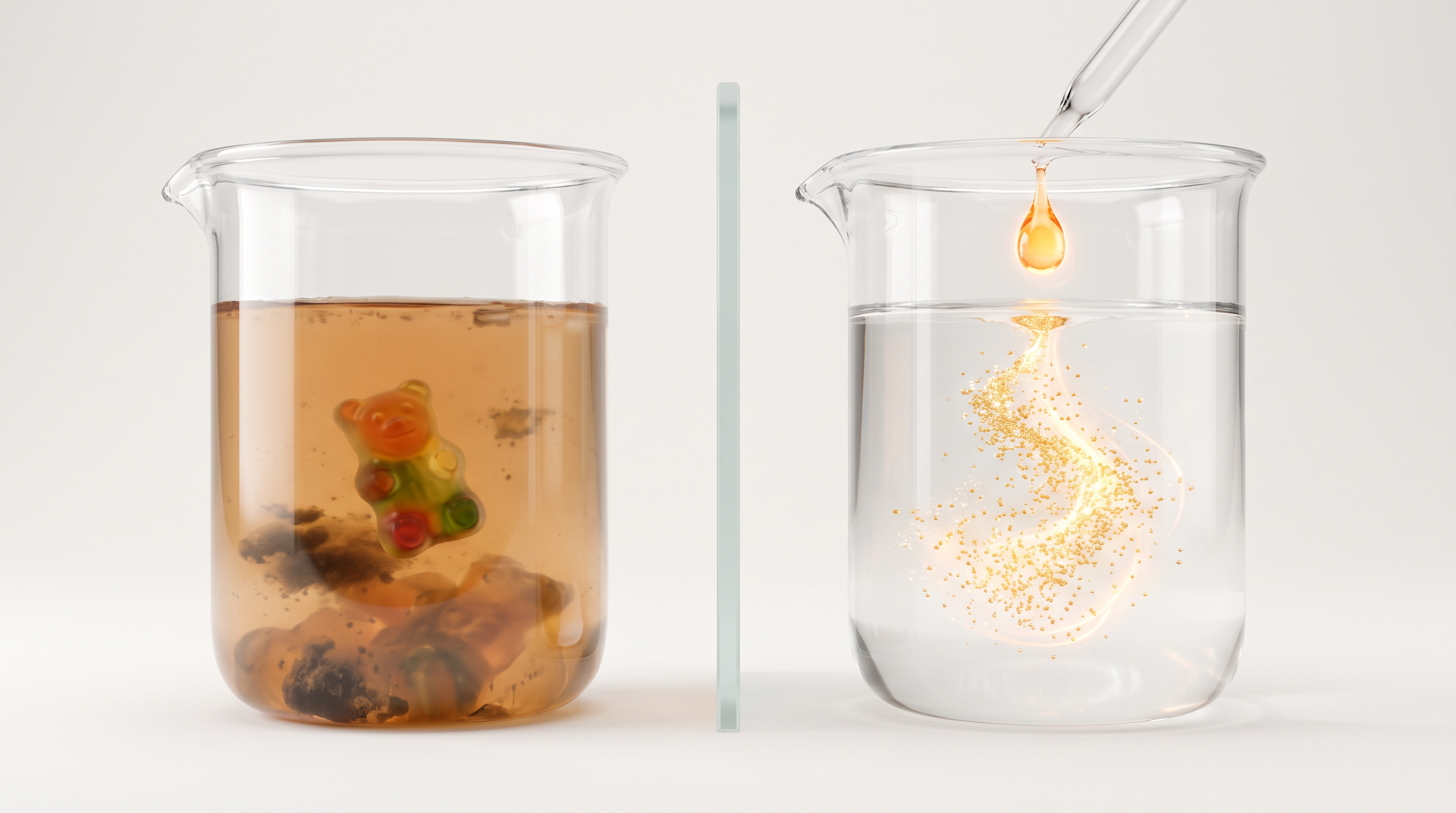
Third-party absorption testing, 2026. Same milligrams on the label — five times the difference in what gets in.
That's lab testing, not a marketing line — and it's why the winner of our test is a liquid, not a candy.
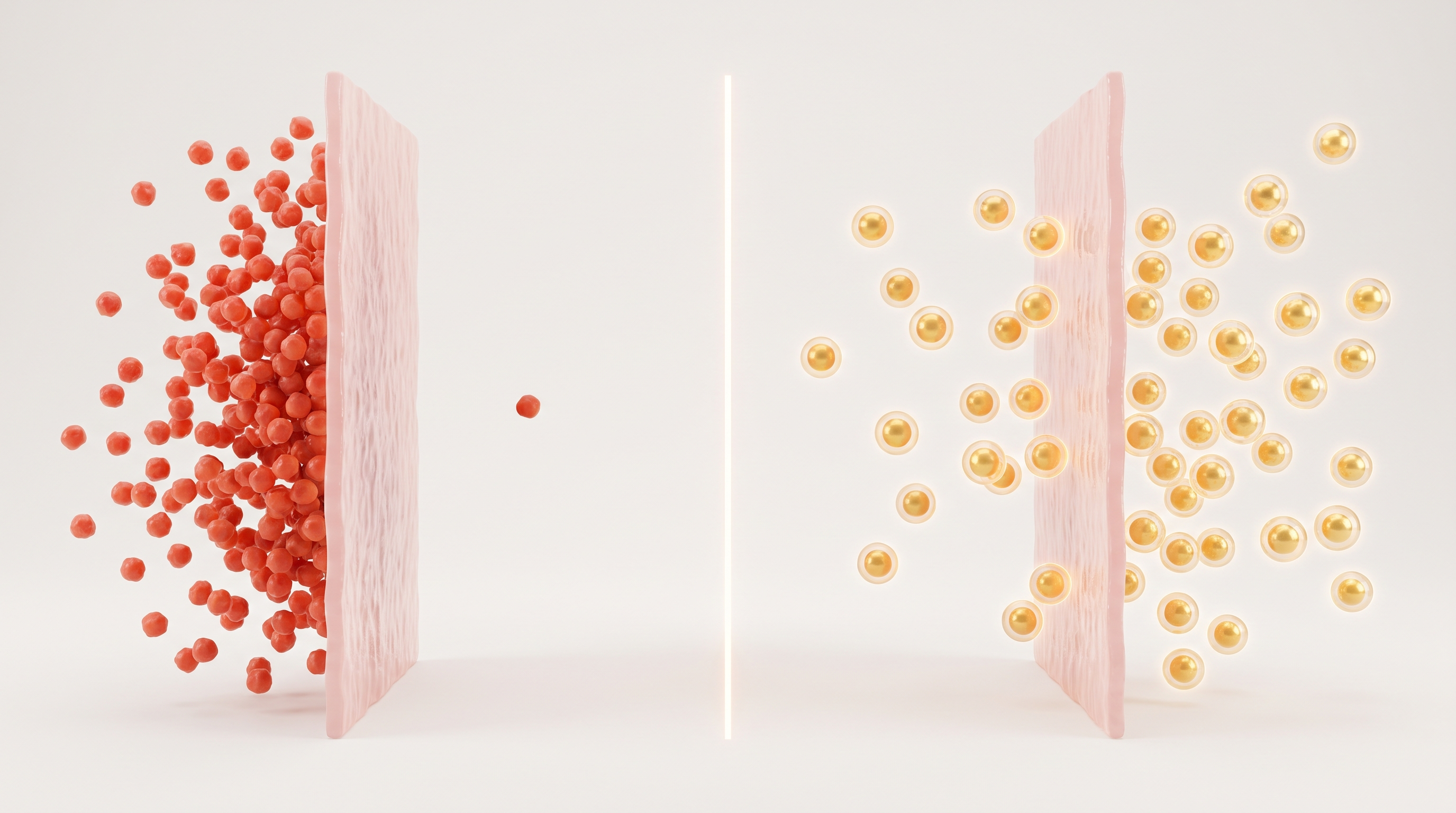
Why a dropper gets through and a gummy doesn't — the shell is the whole difference.
Two bottles can both print "30mg." If one gets in and the other doesn't, they are not the same product. One is a supplement. The other is forty dollars of expensive candy.
How To Buy Saffron That Actually Works
Two numbers, four checks, about thirty seconds. Run any bottle through these before you buy it:
- The Studied Dose, Standardized — The word "extract," 20–30mg, and a safranal percentage beside it. No percentage? Put it back.
- A Format That Survives 60 Mornings — Five seconds, sugar-free, no negotiation. A dropper in juice beats anything your kid gets a vote on.
- Proof It Contains What It Says — Third-party tested, every ingredient at a listed dose. No blends.
- A Form Built To Absorb — Liposomal liquid with absorption data behind it. No data, no deal.
Of the 43 formulas we reviewed, only one passed every test.
We pulled the bestselling kids' saffron supplements from Amazon, Walmart, Target and the brands' own sites, then ran every one against the four checks above — standardized extract, the studied dose, the safranal percentage printed on the label, and proof that it absorbs.
38 of them failed at least one test.
Most failed the same one — the one that decides whether any of it gets into your kid.

Most readers skip ahead here. If you already know what you're looking for — this is it.
See #1 Rated Formula →Saffron prices keep climbing — a price increase is likely. Active subscribers stay locked in at today's price.
2026's Top 5 Saffron Supplements For Kids


PROS
- 98% bioavailability, lab-tested — 5x the absorption of gummies
- 30mg saffron extract, standardized to 6% safranal — the studied dose, printed on the label
- Sugar-free liquid dropper — 5 seconds in juice, nothing to refuse
- Every ingredient at a disclosed dose — no blends
- Stimulant-free — no appetite loss, no 3pm crash
- Third-party tested, made in the USA, 60 servings per bottle
- 60-day money-back guarantee — even on an empty bottle
CONS
- Only available online
- Often sells out due to high demand
The Bottom Line
The only product on this list that passes all four checks — absorption included. The other four hope their milligrams get in. Halla measured it: 98% bioavailability, verified by a third-party lab.
The studied dose, standardized, sugar-free, and in a dropper that makes daily consistency easier. That gives Halla the strongest setup on this list for the broader result parents are actually buying saffron for: more sustained focus, better follow-through, steadier behavior, and smoother days from morning through bedtime.
Nothing on this list asks you to parent harder. This one gives that late-running system the studied dose, in a form the body actually absorbs — and in a form your kid doesn't get a vote on at 7:52am.
Price Note: Saffron is the most expensive spice in the world and its cost keeps climbing. A price increase is likely — but active subscribers are locked in at the current price.


PROS
- Liquid dropper — right format
- Prints the standardization on the label
- Sugar-free, organic, cheap per dose
CONS
- Only 0.3% safranal — 20x below the #1 pick's 6%
- Not a kids' product — no pediatric dosing
- Saffron only, nothing else in the bottle
The Bottom Line
Right format, honest label — and the label is the problem. 88.5mg sounds like three times the studied dose, but at 0.3% safranal it holds a fraction of the active compound. The clearest example on this list of why milligrams alone tell you nothing.
Built for adults, with no children's dosing anywhere on the bottle. Hand it to a seven-year-old and you're guessing.

PROS
- 28mg saffron extract — near the studied range
- Sugar-free, third-party tested, made in USA
- Adds magnesium and vitamin D3
CONS
- No safranal/crocin standardization — 28mg of what?
- Sold as "pixie sticks candy"
- Only 25 servings — not even a month
- Powder sticks spill and get skipped
The Bottom Line
Closer than most: 28mg is a real number near what the studies used. But there's no standardization printed, so it could be a strong extract or a weak one — no way to tell from the bag.
And it's sold as candy, in a 25-count bag that runs out before the first month is done.

PROS
- Uses Affron®, a real standardized extract
- Sugar-free, vegan, made for kids 4+
- Large parent following
CONS
- Saffron mg per gummy isn't published
- Contains St. John's Wort — a known medication-interaction herb, in a kids' product
- Four actives, zero doses listed
- Gummy your kid can refuse — $49.95/month
The Bottom Line
Credit for using Affron®, a real extract — but the amount isn't printed, so you can't compare it to the studied dose. "1 gummy for ages 4–6, 1–2 for 7–12" is a range, not a dose.
The St. John's Wort is what made us pause. It's one of the most interaction-prone herbs on the shelf and rarely recommended for children at all. Talk to the prescriber before the first gummy, not after.

PROS
- Sugar-free
- Cheap — sold as a 2-pack
- Raspberry flavor kids will eat
CONS
- 10+ ingredients in one gummy — saffron is a sprinkle
- No standardization disclosed
- Unknown Amazon-only brand, no track record
- Gummy — dyes, sweeteners, refusable
The Bottom Line
The kitchen-sink gummy: saffron, magnesium, omega-3, holy basil, L-theanine "and more" in one raspberry chew. It looks like the most complete product here. It's the least — a gummy has a few grams of room, and split ten ways nothing gets a real dose.
No standardization. No brand history. No studies. You're not buying a formula, you're trusting a label.
CITATIONS
- https://pubmed.ncbi.nlm.nih.gov/30741567/ — Baziar S, et al. Crocus sativus L. Versus Methylphenidate in Treatment of Children With ADHD. J Child Adolesc Psychopharmacol. 2019.
- https://www.mdpi.com/2072-6643/14/19/4046 — Blasco-Fontecilla H, et al. Efficacy of Saffron as an Add-On to Methylphenidate in Children With ADHD. Nutrients. 2022.
- https://pubmed.ncbi.nlm.nih.gov/29331602/ — Lopresti AL, et al. Affron, a standardised extract from saffron, for youth anxiety and depressive symptoms. J Affect Disord. 2018.
- https://pubmed.ncbi.nlm.nih.gov/32056539/ — Lopresti AL, et al. Effects of saffron on sleep quality in healthy adults with self-reported poor sleep. J Clin Sleep Med. 2020.
- https://www.chop.edu/ — Children's Hospital of Philadelphia, saffron for ADHD (page to confirm)
- https://www.ncbi.nlm.nih.gov/pmc/articles/PMC4599112/ — Khazdair MR, et al. The effects of Crocus sativus (saffron) and its constituents on nervous system. 2015.
- https://pubmed.ncbi.nlm.nih.gov/24299602/ — Hausenblas HA, et al. Saffron and major depressive disorder: a meta-analysis. 2013.
- https://ods.od.nih.gov/factsheets/WYNTK-Consumer/ — NIH Office of Dietary Supplements.
- https://meonutrition.com/ — Saffron supplement analysis, gummy ranking (page to confirm)
- https://pubmed.ncbi.nlm.nih.gov/23698916/ — Harpin V, et al. Long-Term Outcomes of ADHD: A Systematic Review of Self-Esteem and Social Function. J Atten Disord. 2016.
- https://pubmed.ncbi.nlm.nih.gov/18024590/ — Shaw P, et al. Attention-deficit/hyperactivity disorder is characterized by a delay in cortical maturation. Proc Natl Acad Sci USA. 2007. (NIMH imaging study, 446 children.)
- https://www.cdc.gov/adhd/data/index.html — CDC, Data on ADHD in Children; Danielson ML, et al. ADHD Prevalence Among U.S. Children and Adolescents in 2022. J Clin Child Adolesc Psychol. 2024. (6.5M children with current ADHD; 53.6% on medication; 30.1% receiving neither medication nor behavioral treatment.)